If you're reading this, you've likely dabbled with AI in your business already. You've signed up for tools like ChatGPT or Claude, using them for tasks such as writing emails, creating summaries, or crafting content. You've come across discussions about AI agents, automations, and custom GPTs on platforms like LinkedIn, where many claim AI is revolutionizing their operations. Yet, when you examine your business—whether it's your sales pipeline, team productivity, or bottom line—you might notice little to no change. You're not alone. We speak with a multitude of business leaders each month, and they often express a similar sentiment: "We're using AI. I just don't think it's actually doing anything for us."
Using AI vs. Building with AI: Understanding the Distinction
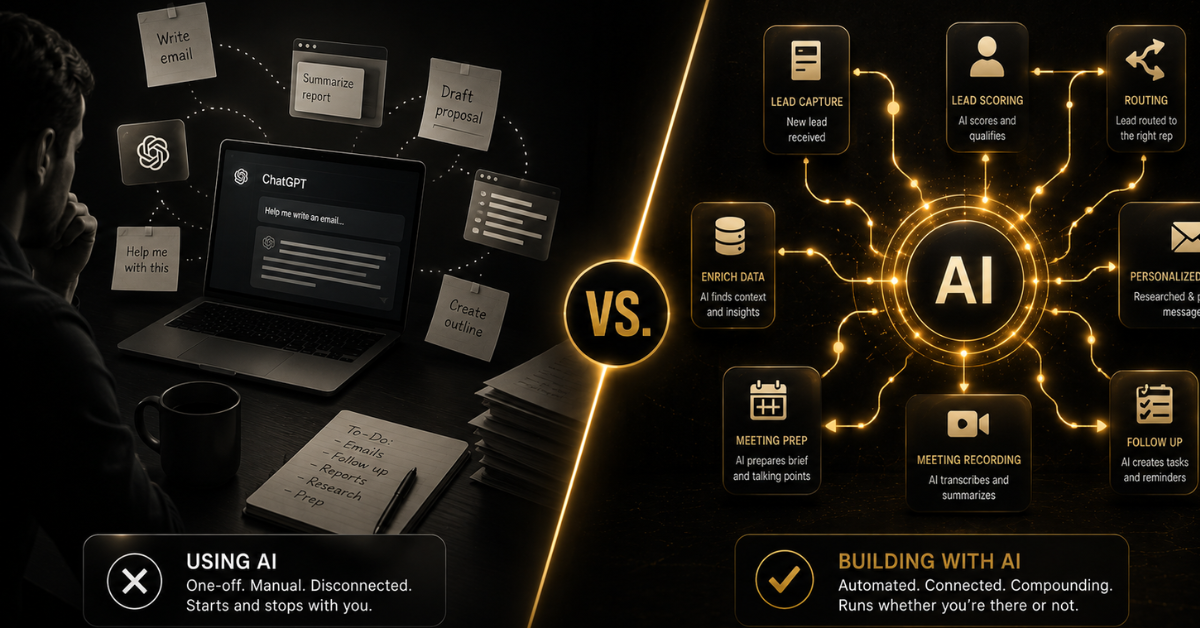
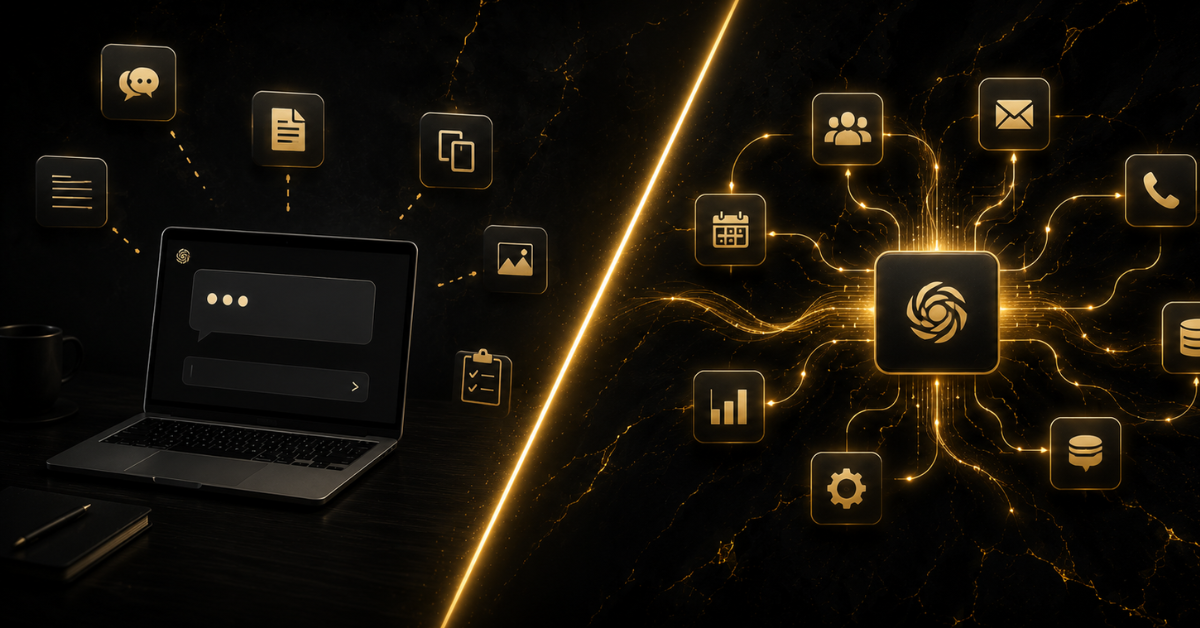
Here's the honest reason behind this common experience: using AI isn't the same as building with AI. When you open ChatGPT to draft an email, you're using AI. It’s beneficial—it might save you ten minutes—but it doesn’t transform your business. It's a more efficient method to accomplish a task you were already doing. Building with AI, however, is a game-changer. It involves designing a workflow—a sequence where AI autonomously performs part of the work every time without requiring manual initiation.
Imagine a lead arriving at 2 AM being scored and routed before anyone is awake, or a cold email that's researched and personalized automatically before an SDR opens their inbox. Picture meeting records being summarized and turned into actionable items before the account executive has even finished their commute home. That’s the difference. One is a tool you decide to use; the other is an infrastructure that operates continuously, regardless of your awareness.
Most companies are caught in the first category. They've trained their teams on ChatGPT and perhaps invested in a few AI tools, but they haven't developed any workflows, so their efforts don’t compound. Every instance of AI usage starts from scratch—opening a tab, entering context, writing prompts, and evaluating outputs. This isn't a system; at best, it's a habit.
Why Companies Stay Stuck
There are three primary reasons why companies struggle to move beyond basic tool usage:
-
Lack of Ownership: Most companies haven't appointed a dedicated AI lead. Marketing may experiment with one tool, sales with another, and operations yet another, leading to disjointed efforts with no cohesive infrastructure. Without someone focused on integrating AI into the business, you end up with scattered experiments rather than a unified strategy.
-
Misconception About Technical Requirements: Many believe building workflows requires technical expertise. This was once true, but not anymore. Platforms like Make.com, Zapier, and no-code builders within ChatGPT and Claude enable anyone with patience to construct actual workflows in just a few hours. The bottleneck is no longer technical skill but rather designing the workflow—understanding what to build and how to connect it effectively.
-
Time Constraints: Teams often find themselves too busy to consider workflow development. With everyone focusing on immediate targets—this quarter’s numbers, weekly deliverables, daily meetings—building AI workflows is relegated to a future project. Consequently, it gets deferred repeatedly, quarter after quarter.
What Actually Works
The companies that achieve tangible results with AI adhere to certain core principles, regardless of their size or industry. They start small by selecting one workflow—not five, not an entire AI strategy—just one specific workflow that addresses a significant problem, often one the team already complains about. Issues such as cold email reply rates, inbound lead routing, meeting preparation, or follow-up consistency often become focal points. They tackle the challenge that causes the loudest pain.
Moreover, these companies build workflows collaboratively with the actual team members who will use them, avoiding top-down rollouts. For instance, SDRs actively participate in designing the SDR workflow. This inclusive approach ensures that AI is not just a tool but a vital component of their infrastructure. The ultimate objective isn't merely to save a few minutes here and there but to create systems that operate autonomously, scaling operations without the need to increase headcount.
Ready to elevate your customer service and business operations with AI? Jump on a quick call to learn more.