If you're reading this, you've probably tried AI in your business already.
You signed up for ChatGPT. Maybe Claude. Maybe both. Your team uses them for emails, for summaries, for the occasional "help me write this" moment. You've heard about agents and automations and custom GPTs. You've seen LinkedIn posts from people who claim AI is changing everything for them. And yet, when you actually look at your business — at your pipeline, your team's productivity, your bottom line — not much has changed.
You're not alone. We talk to dozens of business leaders every month, and almost all of them say some version of the same thing: "We're using AI. I just don't think it's actually doing anything for us."
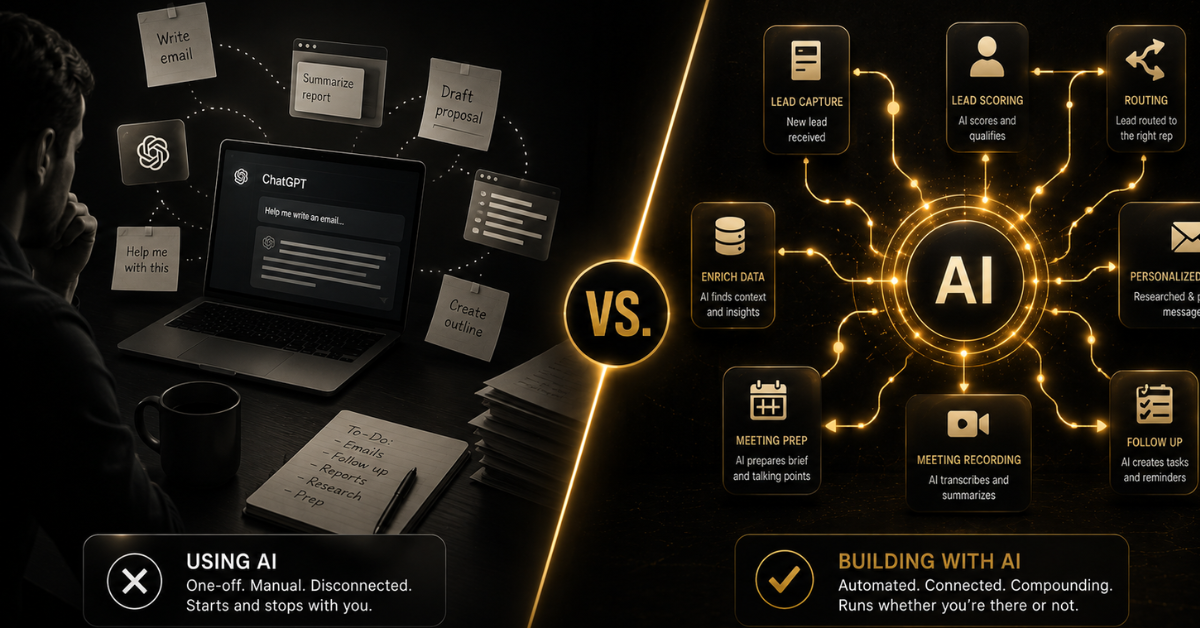
Here's the honest reason why. Using AI isn't the same as building with it.
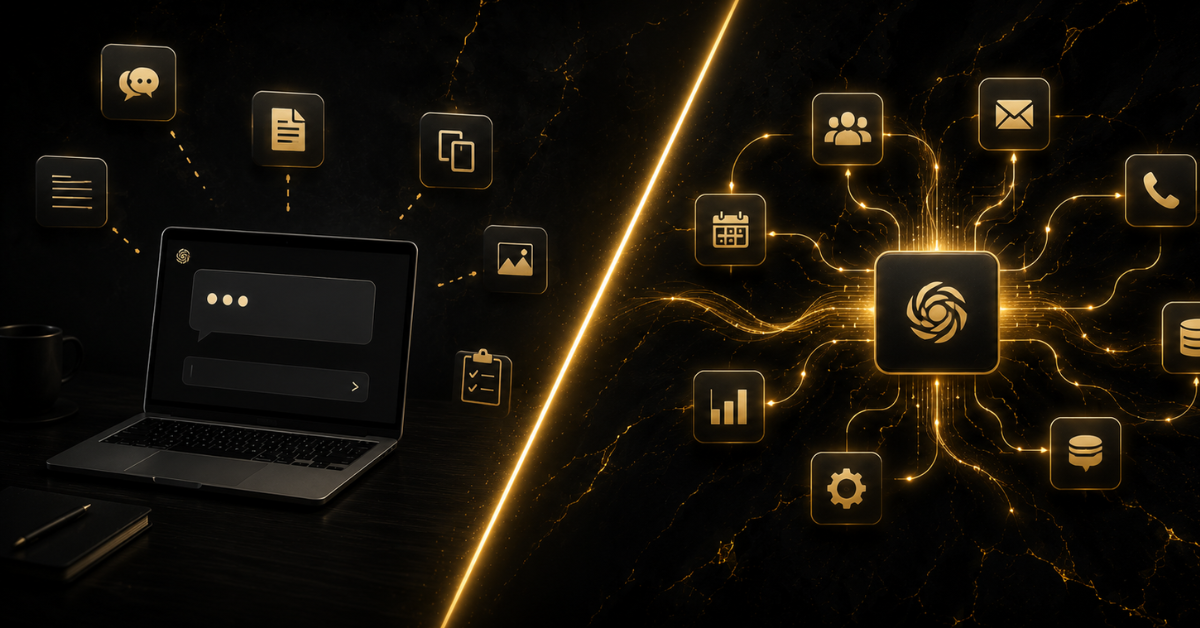
When you open ChatGPT and ask it to help write an email, you're using AI. That's good. It probably saves you 10 minutes. But it doesn't change your business. It's a faster way to do something you were already doing. Building with AI is different. Building means designing a workflow — a sequence where AI does part of the work automatically, every time, without anyone deciding to use it. The lead that came in at 2am gets scored and routed before anyone is awake. The cold email gets researched and personalized before the SDR opens their inbox. The meeting recording gets summarized and turned into action items before the AE has finished their drive home.
That's the difference. One is a tool you remember to use. The other is infrastructure that runs whether you remember it or not.
Most companies are stuck on the first kind. They've trained their team on ChatGPT. They've maybe bought a few AI tools. But they haven't built any workflows. So nothing compounds. Every time someone uses AI, they're starting from scratch — opening a tab, copying their context in, writing a prompt, evaluating the output. That's not a system. That's a habit, at best.
Why companies stay stuck
Three reasons, in order of how often we see them.
The first is that no one owns it. Most companies have no designated AI lead. Marketing experiments with one tool, sales experiments with another, ops uses a third, and nothing connects. Without one person whose job is to think about how AI fits into the business, you get scattered experiments and zero infrastructure.
The second is the assumption that someone needs to be technical to build workflows. This used to be true. It's not anymore. Tools like Make.com, Zapier, and the no-code builders inside ChatGPT and Claude let any reasonably patient person build real workflows in a few hours. The bottleneck isn't technical skill. It's the design — knowing what to build and how to connect it.
The third is the most common: the team is too busy to think about it. Everyone is heads-down on this quarter's number, this week's deliverables, today's meetings. Building AI workflows feels like a future-quarter project. So it gets pushed. Quarter after quarter.
What actually works
The companies that get real results from AI all do the certain fundamentals, regardless of size or industry. They pick one workflow first. Not five. Not "an AI strategy." One specific workflow that solves one specific problem — usually something the team already complains about. Cold email reply rates. Inbound lead routing. Meeting prep. Follow-up consistency. Pick the one with the loudest pain.
They build the workflow with the actual team that will use it. Not as a top-down rollout. The SDRs help design the SDR workflow. The AEs help design the AE workflow. When the people who use it have shaped it, adoption is automatic. When they didn't, you get a beautifully built workflow nobody touches.
They measure honestly. Set a baseline before the workflow goes live. Measure the same metric 30 days later. Be willing to admit if it didn't move the needle. Most people skip this step because they're afraid of what they'll find. The companies that measure consistently are the ones that improve consistently.
Where to actually start
If your business is in the "we use ChatGPT but it isn't really doing anything" phase, the most useful next step isn't to buy another tool. It's to spend 30 minutes mapping the work your team does today and asking one question: where does the same task get repeated, by hand, every week?
That repetition is your first workflow. Build it. Use it for 30 days. See what happens. If you'd rather not figure out the map alone, that's what we do. We help business leaders identify the highest-impact AI workflows for their specific business, and we'll deliver a custom roadmap within four business days of a 30-minute conversation. It's free. No pitch. Just the plan.
You don't need a strategy deck. You need one workflow shipped. That's where it starts.