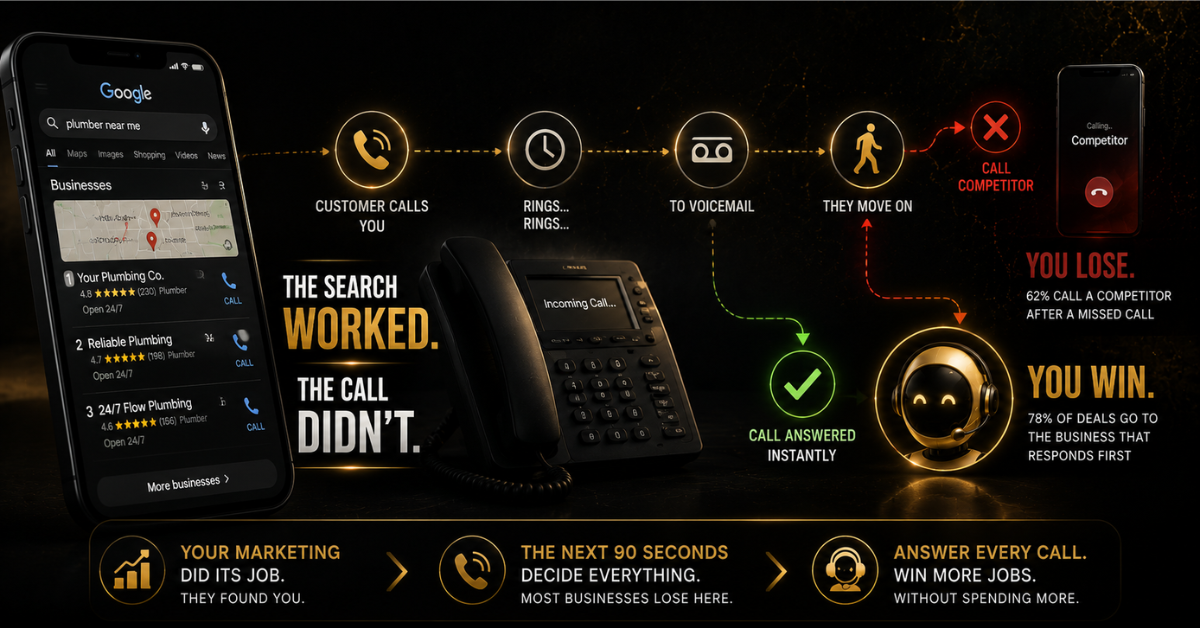
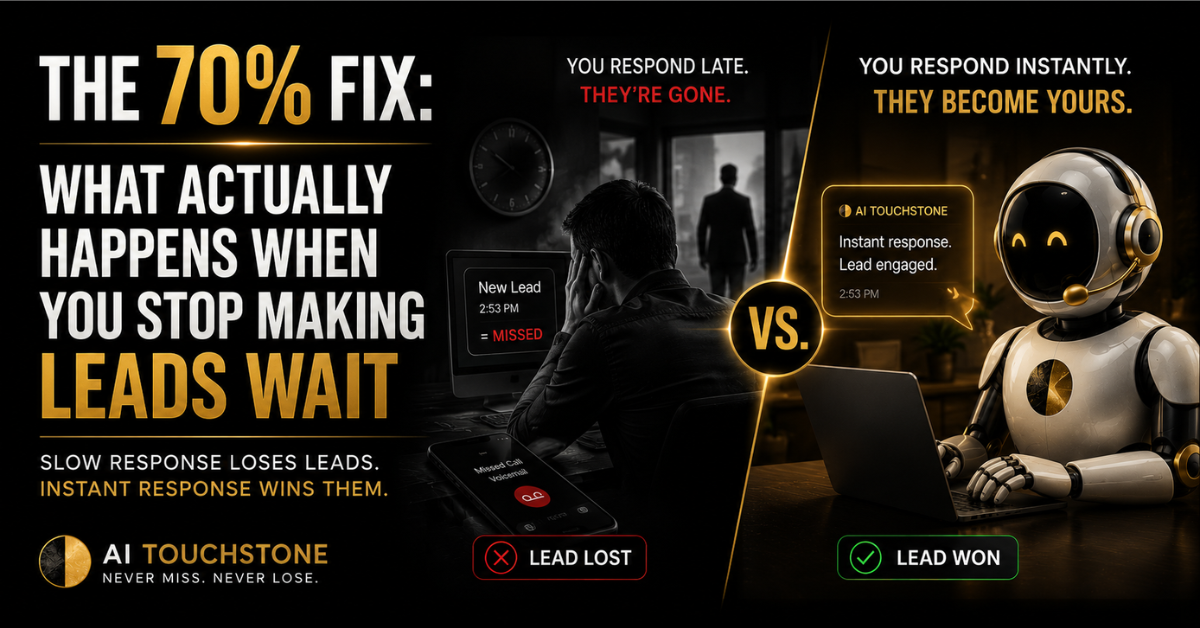
If you're reading this, you've probably had this exact moment: a lead comes in — a form fill, a missed call, a "call me back" voicemail — and by the time someone on your team gets to it, hours have passed. Maybe it's the next morning. You call back, and either they don't pick up, or they mention, a little sheepishly, that they already booked with someone else.
You didn't lose that customer because your product was worse, or your price was too high, or your team didn't care. You lost them because someone else answered first.
We hear a version of this constantly from business owners: "We're not losing leads because they say no. We're losing them because we don't get back to them fast enough." It's rarely framed as a speed problem. It usually gets blamed on the team, the CRM, the follow-up process. But the pattern underneath almost all of it is the same — the gap between "someone reached out" and "someone responded" is where the deal actually dies.
Here's the honest reason this keeps happening: your response time isn't a soft metric. It's the first filter your leads run you through, whether you've measured it or not.
The Real Cost of "We'll Get Back to You"
Live 360 Marketing, a Pittsburgh-based agency handling lead generation for businesses across the country, ran into this directly. Their clients' response times to inbound leads were stretching to 24 to 48 hours — not because anyone was slacking, but because that's just how long it takes when a human has to notice the lead, review it, and find time to call back. In that window, competitors who answered faster simply took the business instead.
They fixed it by putting an AI receptionist in front of every inbound lead, so the moment someone called or filled out a form, they got an answer — not a promise of one. The result: lead-to-appointment conversion went from 49% to 70%. Not from a better sales script. Not from a new offer. From closing the gap between interest and contact.
That's the part worth sitting with. A 21-point swing in conversion, and the product being sold didn't change at all.
This Isn't a One-Off Result
It's fair to wonder whether Live 360's numbers are an outlier — a good case study a vendor likes to publish. They're not, and that's actually the more useful thing to understand. Across the industry, businesses running AI voice agents in production are reporting three-year returns in the 300-plus percent range, with payback periods under six months. The math behind that isn't mysterious: an automated call costs roughly 40 cents to handle, versus $7 to $12 for a human agent to take the same call, and a well-built agent resolves the majority of routine calls — booking, hours, pricing, basic questions — without ever needing a transfer.
None of that means the technology is magic. It means the economics of answering fast are lopsided in your favor once the agent is set up correctly, because the alternative to a fast automated answer usually isn't a slower human answer — it's no answer until someone gets around to it.
Why Speed Beats Almost Everything Else in Sales It's tempting to think of a fast response as a nice-to-have — a small edge on top of a good sales process. In practice, it behaves more like a gate. A lead who's actively comparing options right now is at peak interest the moment they reach out. Every hour that passes, that interest cools, and the odds someone else answers first go up.
This is also why the fix isn't "hire faster people" or "check your CRM more often." Humans have other things to do. They're in meetings, they're with other customers, they're asleep. An AI voice agent doesn't have that constraint — it can pick up the first ring at 11pm on a Saturday exactly as well as it can at 10am on a Tuesday. The advantage isn't that it's smarter than your team. It's that it's always there.
Most businesses already sense this intuitively, which is why so many have tried to patch it with process instead of infrastructure — an auto-reply text, a rule that says "call new leads within the hour," a rotating on-call schedule for after-hours inquiries. Those fixes work until the week gets busy, someone's out sick, or a lead calls in at a time nobody planned for. The gap doesn't close permanently until something is answering every time, not most of the time.
The lead you respond to in 30 seconds and the lead you respond to in 30 hours are not the same lead anymore.
What This Actually Looks Like Day to Day
For most businesses, the leads that slip through aren't complicated ones. They're simple: someone wants to know if you're available, what something costs, or whether they can book a time. Those are exactly the questions a well-built voice agent can answer immediately, without waiting for a callback. The complex, judgment-heavy conversations still go to your team — the agent's job is just to make sure nobody sits in silence while they wait for one.
That distinction matters, because it changes what you're actually buying. You're not replacing your sales team with a robot. You're removing the delay that happens before your sales team even gets a chance to do their job.
Picture the version of this that's easy to overlook: a Tuesday at 6:45pm, after your office has closed for the day, a lead calls to ask if you're taking new appointments this week. Under the old model, that call goes to voicemail, and you call back Wednesday morning, if you remember, and if they haven't already called the next name on their list. Under the fixed model, the call gets answered at 6:45pm, the appointment gets checked against your calendar, and by the time you open up Wednesday morning, it's already booked. Nothing about your service changed. The only thing that changed is that someone answered the phone.
Where to Actually Start
If you already suspect leads are cooling off before anyone calls them back, you don't need a full audit to confirm it. Just check how long it typically takes your team to respond to a new inbound lead right now — most business owners are surprised by the number once they actually time it.
That number is your starting point. If it's measured in hours instead of seconds, that's the gap costing you business every week, whether or not it shows up on a report. It doesn't require ripping out your CRM, hiring anyone new, or changing how your team works today — it just requires making sure something is always ready to pick up first.
We help business owners figure out exactly where that gap is in their own lead flow and what it would take to close it with a voice agent built around how their business actually works.
You don't need to overhaul your sales process to see a result like Live 360's. You need to stop making leads wait.