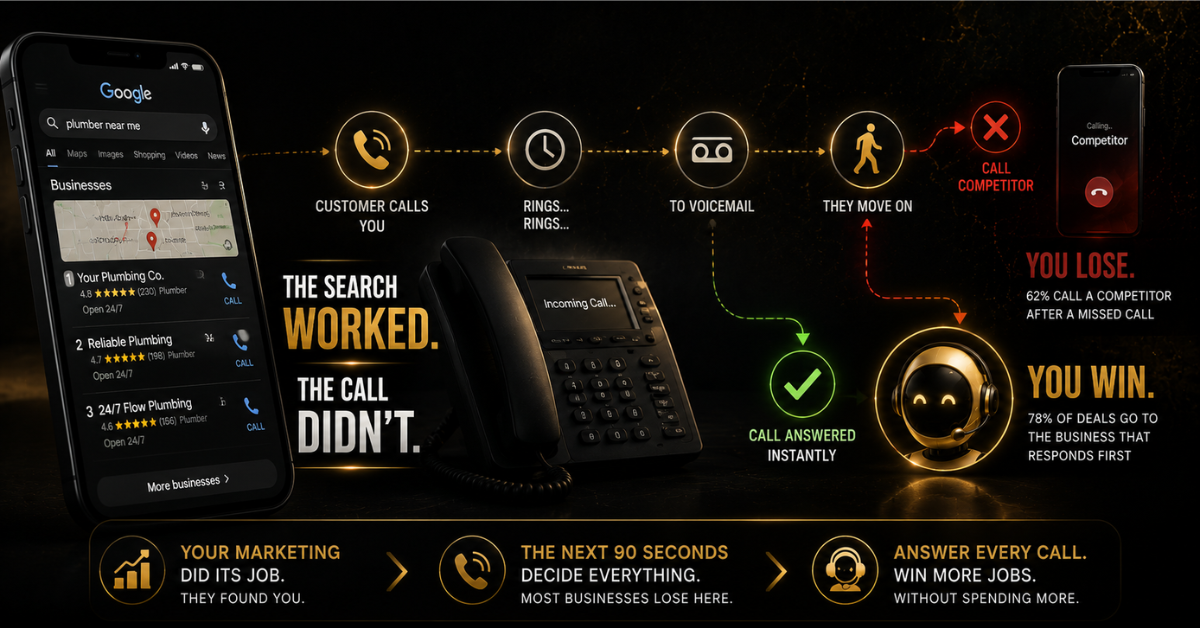

Imagine this: You dial a business, and after four rings, your call drops to voicemail. What do you do next? Like many, you probably hang up and contact the next business on your list. For small businesses, this scenario is all too common and results in lost customers before they're even aware they had an opportunity.
Many business owners misinterpret this as a capacity issue, citing small teams or the inability to manage calls while out in the field. The real issue, however, is a revenue problem. A missed call equals a missed customer, which directly impacts your bottom line. Fortunately, resolving this doesn't necessitate hiring a full-time receptionist.
The Bar Is Lower Than You Think
When small businesses consider enhancing customer experience, they often aim for the complex: superior service, faster delivery, more personalized interactions. While these aspects are important, there's a more fundamental expectation that must be met first: availability.
The basic question is, "Does someone actually pick up the phone?" This is the first hurdle. Before you can demonstrate your expertise or charm customers with exceptional service, you must be reachable. For many small businesses, particularly in trades, healthcare, and professional services, this is where the gap lies.
Consider a two-person plumbing operation. The plumber is busy fixing a leak when the phone rings. A dental office might be mid-procedure. The contractor is hands-on at a job site. Because of these demands, calls go unanswered, and potential customers, ready to make a purchase, move on to a competitor who answers.
The Two Options Most Businesses Default To
Currently, small businesses with limited resources for full-time phone coverage often default to two options:
-
Voicemail: Calls go to a standard message, and most customers hang up without leaving a message. Even if they do, by the time you return the call, they may have already booked with a competitor.
-
Hire a Receptionist: This involves a significant financial commitment, with salaries ranging from $35,000 to $50,000 annually, not including benefits. Yet, this solution still leaves gaps, like after-hours coverage and high call volumes during peak times.
Neither of these solutions is ideal. However, there's a third option that many small businesses have yet to fully explore.
What a Voice AI Agent Actually Does
A well-designed AI voice agent can revolutionize the way your business handles calls. It answers the phone after one ring, 24/7. It greets callers professionally, determines the purpose of their call, and manages it—whether it's scheduling an appointment, answering FAQs, gathering contact info, or directing the call to the right person.
For routine, predictable calls, a voice agent is efficient, consistent, and never puts a caller on hold. It doesn't miss work due to illness, isn't overwhelmed by a spike in call volume, and doesn't clock out at the end of the day. For most businesses, a voice agent efficiently manages the majority of inbound calls, ensuring that potential customers don't turn to competitors.
The Part People Get Wrong
Let's be clear: voice AI isn't a cure-all. While it excels at handling routine tasks like scheduling and answering basic queries, it's not suited for every call type. High-stakes conversations, complex complaints, or situations requiring empathy and nuance should be directed to a human.
Some businesses make the mistake of treating AI as a replacement for human judgment, offering no pathway to a real person. This can lead to frustration when callers encounter unexpected issues that the AI can't resolve, damaging customer relationships in the process.
The optimal approach is a seamless handoff from AI to human when necessary. AI addresses what it's designed to, and when it's out of its depth, a human takes over. This balance builds trust with both the AI and your business as a whole.
"Something Is Better Than Nothing" — and Here's What I Mean by That
To clarify, I'm not advocating for deploying any solution and considering the job done. Instead, recognize that many small businesses are currently setting a very low bar. A well-constructed voice agent surpasses voicemail in significant ways.
Voicemail is passive. It requires the customer to leave a message, wait for a callback, be available when you return the call, and maintain their interest. The potential for drop-off at every step is substantial.
Conversely, a voice agent is active. It engages callers immediately, gathers necessary information, and often resolves their queries on the spot. No callbacks, no cooling leads, no lost customers to competitors who answer first.
For businesses where after-hours calls go unanswered, peak volumes overwhelm small teams, or owners are in the field when the phone rings, a voice agent that answers is a game-changer compared to a voicemail that languishes unchecked.
Who This Is For
Voice AI offers the most value to businesses with high call volumes, small teams, and services reliant on responsiveness. Examples include:
- Home Services: Plumbing, HVAC, electrical, and landscaping businesses thrive on immediate contact. Customers with urgent needs will choose the first responder.
- Healthcare Practices: Scheduling is crucial. A voice agent that books appointments after hours or handles overflow can directly boost revenue.
- Legal and Professional Services: First impressions matter. A professional, immediate response can set a positive tone that voicemail can't match.
- Real Estate and Financial Services: Leads are often time-sensitive. A prompt response can mean the difference between gaining or losing a client.
If your business fits these profiles and struggles with unanswered calls during peak times or after hours, exploring voice AI could be transformative.
What AI Touchstone Builds
At AI Touchstone, we specialize in crafting custom voice agents tailored to businesses that lose customers due to unanswered calls. Our voice agents are:
- Expertly scripted for your business, services, and customer interactions
- Designed with escalation, ensuring a smooth transition to human interaction when necessary
- Available 24/7, eliminating the risk of sending potential customers to voicemail at inconvenient times
- Transparent about their AI nature, because informed customers who receive excellent service are invaluable
We don't offer generic solutions. Instead, we work with you to understand your call patterns, identify where a voice agent can add value, and build a solution that fits your needs. Sometimes this means a full 24/7 agent; other times, it's focused on after-hours coverage. It all depends on where you're losing calls and their importance to your business.
The Bottom Line
Your competitors aren't standing still. Businesses in your field adopting voice AI are capturing the calls you're missing. This isn't a hypothetical—it's a reality driven by customer decision-making.
When customers call, your response can win their business. If you don't answer, they will move to someone who does. Consider how many calls you're willing to miss before recognizing it's a problem worth addressing.
If you're prepared to stop losing customers to voicemail, it's time to talk. Simply email darion@aitouchstone.com or call 414-441-1080 to schedule an appointment.